
The Role of Technology in Streamlining Crew Changes: An Indonesian Perspective
Technology in streamlining crew changes has become increasingly important, especially in Indonesia where operations involve multiple authorities, ports, and logistical processes. Efficiency today depends not only on coordination, but also on how information is managed, shared, and executed at every stage of the process.
Crew Change in Indonesia: Why Efficiency Can Be Challenging
Crew change operations in Indonesia involve more than simply moving personnel from one location to another. Each process must be coordinated with immigration, port authorities, health regulations, transportation providers, and vessel schedules.
Every step requires proper documentation, approvals, and precise timing. Even small delays in one stage can affect the entire sequence. When these processes are handled manually or separately, coordination becomes more difficult.
Delays often occur not because of major issues, but due to small gaps such as incomplete documents, late updates, or misaligned schedules. Over time, these small gaps can reduce overall efficiency and create unnecessary pressure during operations.
Technology helps reduce these risks by improving how information is organized and shared.
Where Traditional Processes Often Slow Down
In many cases, inefficiencies begin with how information is handled and communicated.
Crew data is often stored in different places, including emails, spreadsheets, and messaging platforms. This makes it difficult to maintain a single, accurate version of information. Updates may not reach all parties at the same time, and approval status may not always be clear.
Travel arrangements may also be planned separately from vessel schedules, which can lead to mismatches in timing. When this happens, adjustments must be made at the last minute, which increases the risk of delays.
Although each issue may seem small, their combined effect can significantly impact the overall operation.
How Technology Supports a More Efficient Process
- Centralized Documentation and Data Management
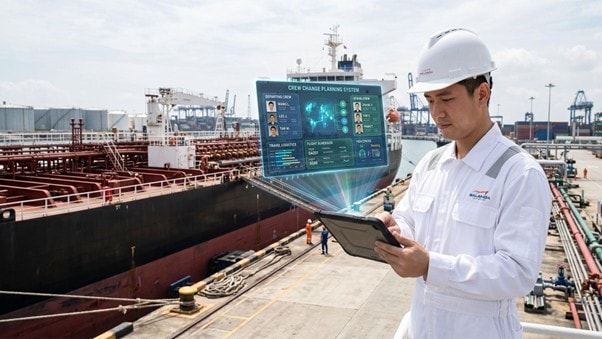
Technology allows all crew-related information to be stored within one system.
Documents such as passports, visas, crew lists, medical certificates, and travel details can be accessed easily and updated in real time. This reduces the need to send repeated files and lowers the risk of outdated information being used.
With centralized data, all stakeholders are able to work with the same information, which improves accuracy and coordination.
2. Real-Time Visibility Across Operations
Improved visibility allows operations to be managed more effectively.
Digital systems provide real-time updates on each stage of the crew change process. This includes document approval status, flight schedules, transportation progress, and vessel readiness.
When information is available in real time, potential issues can be identified earlier. This allows teams to take action before delays occur, rather than reacting after problems have already developed.
3. More Efficient Communication
Technology helps ensure that communication remains clear, consistent, and timely.
Instead of relying on separate communication channels, integrated systems allow updates to be shared instantly with all relevant parties. Ship agents, vessel crew, operators, and service providers can all access the same information at the same time.
This reduces misunderstandings and ensures that everyone is aligned throughout the process.
4. Digital Submission to Authorities
Crew change operations require coordination with multiple authorities in Indonesia, including immigration, port health, and port administration.
Digital systems allow documents to be prepared, reviewed, and submitted more efficiently. Although some processes still require physical verification, the use of electronic documentation has reduced processing time in many ports.
This creates a more structured and predictable approval process.
Digital systems allow documents to be prepared, reviewed, and submitted more efficiently. Although some processes still require physical verification, the use of electronic documentation has reduced processing time in many ports. This efficiency is most effective when integrated into the broader administrative workflow; for example, leveraging technology for efficient port clearance ensures that crew arrivals are perfectly synchronized with customs and harbor master approvals. This creates a more structured and predictable approval process for the entire vessel.
5. Integration with Travel and Logistics
Crew change operations depend heavily on travel arrangements and local transportation.
Technology allows better integration between crew management systems and travel coordination. Flight bookings, itinerary updates, and transport arrangements can be managed in one system.
This ensures that crew movement is aligned with vessel schedules and port activities, reducing the need for last-minute adjustments.
The Role of Execution Alongside Technology
Technology supports operations, but it does not replace execution on the ground.
Crew change still requires proper coordination with authorities, transport providers, and vessel teams. Each step must be carried out carefully to ensure compliance with regulations and smooth movement of personnel.
Technology improves efficiency by supporting these processes, but successful operations still depend on proper planning and execution.
Why Technology Matters in Indonesia
Indonesia has a wide network of ports, each with its own procedures and operational conditions.
Managing crew changes across different locations can be complex, especially when dealing with varying requirements and infrastructure. Technology helps create consistency by standardizing how information is handled and shared.
This is particularly important in remote areas, where coordination challenges can be greater and communication may be more limited.
Practical Impact on Crew Change Efficiency
When technology is applied correctly, it provides clear operational benefits.
Documentation can be prepared more quickly and with fewer errors. Approval processes become easier to track, and communication becomes more structured. Travel arrangements can also be aligned more closely with vessel schedules.
Most importantly, issues can be identified earlier, allowing teams to make timely adjustments and maintain smooth operations.
Supporting More Reliable Crew Change Operations
Technology in streamlining crew changes supports a more organized and consistent process.
Balancia Ship Agency applies digital tools to improve coordination across Indonesian ports. Crew documentation is managed in one system, updates are tracked in real time, and logistics are aligned with vessel schedules to ensure smooth execution.
This approach helps ensure that crew changes are carried out efficiently, with better control and predictability across every stage of the process.
BALANCIA SHIP AGENCY
HQ Address : Komplex Ruko Golden City Block C No.3A, Batam City, Indonesia 29432
www.balancia.co.id
Mobile Ph. : +628112929654
Office Ph. : +627784883769
References:
- Efficient ship operations and crew deployment. (n.d.). Retrieved from Sertica: https://www.sertica.com/modules/crew-management/#gref
- Optimizing Supply Chain Efficiency with Dwell Time Management. (2023, December 25). Retrieved from Windward: https://windward.ai/blog/dwell-time-managements-critical-role-in-maximizing-supply-chain-efficiency/