
Underwater Cleaning in Indonesia: How Ship Agencies Support Efficient and Environmentally Sound Operations
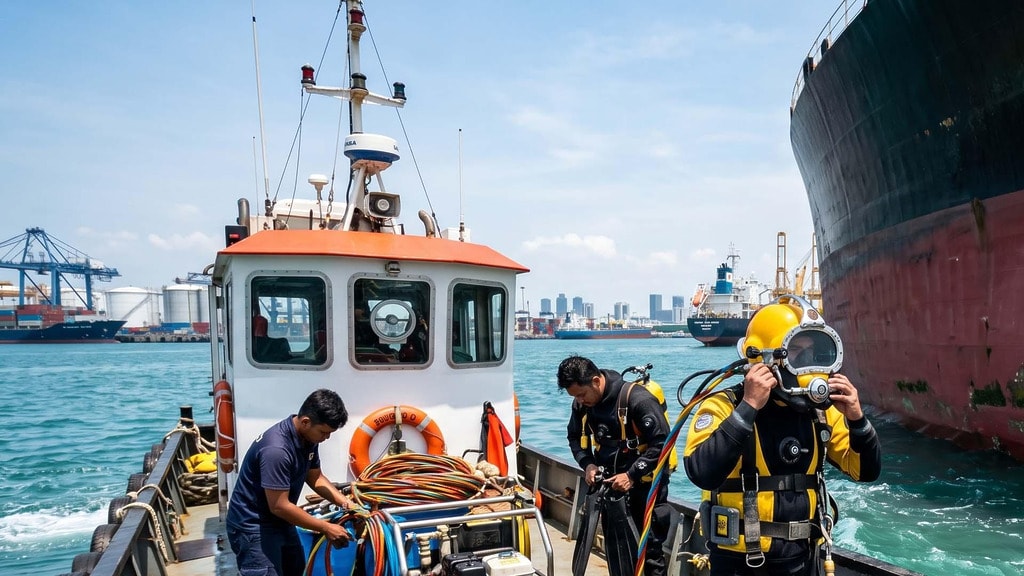
Marine growth can slow a vessel down and increase fuel consumption over time. Underwater cleaning in Indonesia helps keep the hull, propeller, and sea chest in better condition during port calls, anchorage stays, or reactivation planning. With ship agency coordination, the service can be arranged more safely, efficiently, and in line with local environmental requirements.
Why Underwater Cleaning Is Needed
Vessels operating in tropical waters are more exposed to hull fouling because warm sea conditions can support faster marine growth. When fouling builds up on the hull, propeller, rudder, or sea chest, the vessel may lose efficiency and require more fuel to maintain performance.
For shipowners and operators, underwater cleaning is usually considered when a vessel has been idle at anchorage, waiting for cargo operations, staying in lay-up, preparing for reactivation, or showing signs of reduced speed. It can also be arranged before charter requirements, technical inspections, dry docking preparation, or long voyages.
The International Maritime Organization explains that biofouling is the build-up of aquatic organisms on ships’ submerged surfaces. It can also contribute to the transfer of invasive aquatic species when organisms are carried from one marine environment to another. IMO’s 2023 Biofouling Guidelines were developed to help reduce this risk through better biofouling management.
For vessels calling Indonesian ports and anchorages, underwater cleaning should not be seen only as a performance service. It is also part of responsible vessel maintenance when planned with proper safety checks, environmental awareness, and local coordination.
What Services Are Included in Underwater Cleaning Operations?
Underwater cleaning operations may cover several areas depending on the vessel’s condition, service objective, and local permission. The final scope should be confirmed after reviewing the vessel’s position, fouling level, safety condition, and operational schedule.
| Service | Purpose | Operational benefit |
| Hull cleaning | Removes marine growth from hull surfaces | Helps reduce drag and improve vessel efficiency |
| Propeller polishing | Cleans and smooths the propeller surface | Supports better propulsion performance |
| Sea chest cleaning | Removes fouling near seawater intake areas | Helps maintain cooling and intake function |
| Rudder cleaning | Cleans the rudder and nearby underwater areas | Supports better maneuvering performance |
| Niche area cleaning | Cleans complex submerged areas | Helps control hidden fouling build-up |
| Underwater inspection | Checks hull, propeller, rudder, anodes, and damage | Supports technical decision-making |
| Photo and video reporting | Provides visual evidence before and after service | Supports owner and superintendent review |
In many cases, owners begin with underwater inspection before deciding the full cleaning scope. This helps avoid unnecessary work and gives the technical team clearer evidence of the vessel’s underwater condition.
How Ship Agencies Support Underwater Cleaning in Indonesia
A ship agency helps coordinate the local execution of underwater cleaning. The agency does not replace the diving contractor, superintendent, class surveyor, or local authority. Instead, it connects each party so the operation can be arranged properly at the vessel’s location.
For underwater cleaning in Indonesia, a ship agency may assist with permission checks, diving team arrangement, vessel schedule confirmation, launch boat or service boat coordination, safety communication, and report collection. The agency also helps align the service with the vessel’s port call, anchorage stay, or shipyard schedule.
For underwater cleaning in Indonesia, a ship agency may assist with permission checks, diving team arrangement, vessel schedule confirmation, launch boat or service boat coordination, safety communication, and report collection. The agency also helps align the service with the vessel’s port call, anchorage stay, or shipyard schedule. This level of local coordination is standard across all facets of a vessel’s stay. Working with an authorized partner ensures that these technical deployments comply fully with overarching ship agency services in Indonesia, which govern everything from initial harbor master notifications to final port clearance paperwork.
This coordination is important because underwater work depends on many local factors. Strong current, poor visibility, restricted port areas, terminal rules, vessel movement, weather, and traffic conditions can affect whether cleaning can be performed safely. In some locations, underwater cleaning may require prior approval or may be restricted depending on environmental and operational conditions.
A well-coordinated ship agency can help the owner understand what is practical before the diving team is mobilized.
Environmental Compliance
Underwater cleaning must be planned with environmental care because biofouling material and coating residues may enter the water if the cleaning method is not controlled. This is why environmental requirements should be checked before the service begins, especially in port areas, anchorages, shipyards, or sensitive waters.
According to IMO’s 2025 Guidance on In-Water Cleaning of Ships’ Biofouling, in-water cleaning should be planned and performed with attention to environmental risk, ship coating condition, pre-cleaning inspection, post-cleaning inspection, record-keeping, and reporting. This point has been paraphrased and adapted here for practical underwater cleaning planning in Indonesia.
The same IMO guidance also supports the wider application of the 2023 Biofouling Guidelines, which aim to minimize the transfer of invasive aquatic species through biofouling management. BIMCO reported in February 2025 that IMO’s Pollution Prevention and Response Sub-Committee finalized in-water cleaning guidance in line with the 2023 Biofouling Guidelines.
For shipowners, this means underwater cleaning should not be judged only by speed or price. The fouling level, cleaning method, local permission, waste control, coating protection, and reporting quality should also be considered before work begins.
Practical Steps Before Arranging Underwater Cleaning
A successful underwater cleaning operation usually starts with clear service information. The owner or operator should confirm what needs to be cleaned, where the vessel is positioned, and when the vessel is available for underwater work.
A practical process may include:
- Confirm the vessel’s location, schedule, and required cleaning scope.
- Check whether underwater cleaning is allowed at the port, anchorage, or shipyard.
- Review tide, current, visibility, traffic, and vessel safety condition.
- Arrange a suitable underwater service team.
- Coordinate access, launch boat, safety communication, and timing.
- Complete the cleaning or inspection work.
- Collect photo, video, and service reports after completion.
This process helps reduce confusion between the vessel, shipowner, local agent, diving team, and port stakeholders. It also creates a clearer record for the owner’s technical team.
Documents and Details Commonly Needed
Requirements may vary by port, anchorage, terminal, and contractor. However, the following details are usually helpful before arranging underwater cleaning in Indonesia:
- Vessel name and IMO number
- Vessel position or berth details
- Vessel particulars
- Required cleaning scope
- Hull area or underwater section to be cleaned
- Estimated service date and time
- Draft condition
- Onboard safety contact
- Port or terminal restrictions, if any
- Photo or video reporting requirement
- Agency appointment or service instruction
Early information allows the ship agency to check feasibility, service availability, safety conditions, and local requirements before confirming the work.
Balancia Ship Agency Support for Underwater Cleaning in Indonesia
Balancia Ship Agency supports shipowners, vessel operators, charterers, and maritime professionals that require underwater cleaning in Indonesia. As a husbandry specialist across Indonesia, Balancia can coordinate underwater cleaning operations together with port agency support, crew change, CTM, spare parts delivery, provisions, fresh water, technician attendance, and vessel attendance.
For underwater services, Balancia helps coordinate the local process from initial request to completion report. This includes checking service feasibility, arranging suitable underwater teams, coordinating vessel access, supporting safety communication, and collecting photo or video documentation after work is completed.
Efficient underwater cleaning is not only about removing marine growth. It is about arranging the right service, at the right location, with proper safety and environmental controls. With ship agency coordination, underwater cleaning operations in Indonesia can be handled more smoothly, transparently, and responsibly.
People Also Ask About Underwater Cleaning in Indonesia
What is underwater cleaning in shipping?
Underwater cleaning is the cleaning of submerged vessel areas while the ship remains afloat. It may include hull cleaning, propeller polishing, sea chest cleaning, rudder cleaning, niche area cleaning, and underwater inspection.
Is underwater cleaning allowed in Indonesia?
Underwater cleaning may be arranged in Indonesia, but conditions can vary by port, anchorage, terminal, shipyard, and local authority. Permission, safety conditions, fouling level, and environmental requirements should be checked before work begins.
How does a ship agency support underwater cleaning operations?
A ship agency coordinates permission checks, underwater service providers, vessel access, timing, launch boat support, safety communication, and service reporting. This helps the owner arrange the work more smoothly from planning to completion.
Why is environmental control important during underwater cleaning?
Environmental control is important because removed biofouling and coating residues may enter the water. IMO guidance highlights planning, inspection, record-keeping, reporting, and biofouling management to reduce environmental risk and the transfer of invasive aquatic species.
Can underwater cleaning improve vessel efficiency?
Yes. Removing hull and propeller fouling can help reduce resistance and support better propulsion performance. The actual improvement depends on fouling level, vessel type, operating speed, cleaning quality, and hull coating condition.
BALANCIA SHIP AGENCY
HQ Address : Komplex Ruko Golden City Block C No.3A, Batam City, Indonesia 29432
www.balancia.co.id
Mobile Ph. : +628112929654
Office Ph. : +627784883769
References:
- Biofouling. (n.d.). Retrieved from International Maritime Organization: https://www.imo.org/en/ourwork/environment/pages/biofouling.aspx
- MEPC.1/Circ.918 Guidance on In-Water Cleaning of Ships’ Biofouling. (2025, April 29). Retrieved from International Maritime Organization: https://wwwcdn.imo.org/localresources/en/OurWork/Environment/Documents/Biofouling%20pages/MEPC.1-Circ.918%20-%20Guidance%20On%20In-Water%20Cleaning%20Of%20Ships%27%20Biofouling%20%28Secretariat%29.pdf
- Guidance on In-water Cleaning of Ship’s Biofouling. (2025, October 30). Retrieved from Hong Kong Marine Department: https://www.mardep.gov.hk/filemanager/en/share/msnote/pdf/msin2560.pdf
- In-water cleaning guidance finalised by the IMO’s Pollution Prevention and Response Sub-Committee. (2025, February 3). Retrieved from BIMCO: https://www.bimco.org/news-insights/bimco-news/2025/02/03-inwater-cleaning/