
The Role of a Ship Agency in Facilitating Customs Clearance in Indonesian Ports: A Step-by-Step Guide
Customs clearance in Indonesia must be handled carefully before vessel activities can be completed smoothly. Cargo information, vessel documents, customs declarations, and authority coordination are all involved in the process. Through proper ship agency support, each requirement can be prepared, submitted, and followed up in accordance with Indonesian port procedures.
How Customs Clearance Is Managed in Indonesian Ports
Customs clearance forms part of the wider port clearance process. It is related to how cargo, ship stores, spare parts, equipment, and other vessel-related materials are declared and controlled when a vessel enters or leaves an Indonesian customs area.
In Indonesian ports, customs procedures are usually connected with other formalities, including immigration, quarantine, port health, and harbour master requirements. For this reason, accuracy and timing must be maintained throughout the process. If customs documents are incomplete or inconsistent, the wider clearance process may also be affected.
Through the ship agency, required documents are collected, checked, submitted, and coordinated with Customs and other related parties.
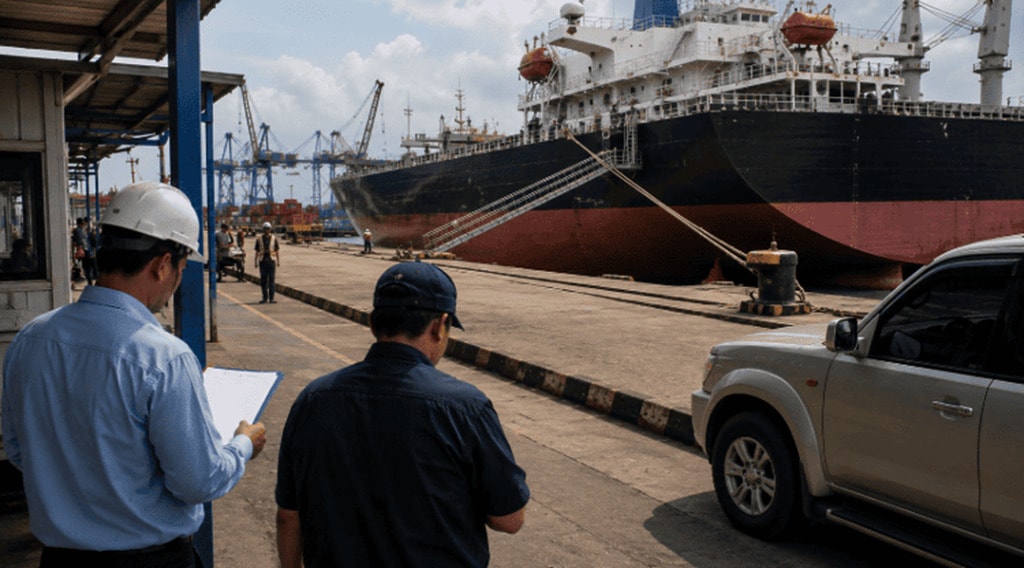
Step 1: Pre-Arrival Document Preparation
The customs clearance process is started before the vessel arrives.
At this stage, required documents are collected from the vessel, principal, or related parties. These may include vessel particulars, cargo documents, crew list, ship stores declaration, spare parts details, and supporting information related to the vessel’s call.
All information must be checked carefully before submission. Any mismatch in vessel details, cargo description, or supporting documents may create additional verification during processing.
Step 2: Submission of Arrival Information
Before the vessel enters port, arrival information must be submitted according to the required procedure and timeline. Through proper agency handling, voyage details, cargo information, shipper or consignee data, and related supporting documents can be aligned before submission. This helps the review process move more smoothly. Managing these customs filings early is a critical component of a vessel’s wider arrival formalities, setting the tone for the entire port call. For a comprehensive look at how these initial workflows fit into broader port turnarounds, see our guide on coordinating your vessel’s arrival procedures and operational transitions.
This may include the vessel arrival plan, inward manifest, and supporting customs documents. The submitted data must reflect the actual cargo and vessel condition.
Through proper agency handling, voyage details, cargo information, shipper or consignee data, and related supporting documents can be aligned before submission. This helps the review process move more smoothly.
Step 3: Customs Review and Verification
After submission, the declared information may be reviewed by Customs.
This review is carried out to confirm whether cargo, stores, spare parts, and other vessel-related items have been properly declared. If clarification is requested, the required information must be provided through coordination with the vessel, principal, consignee, or service provider.
This stage can become complicated when differences are found between the manifest, cargo documents, and supporting declarations. For that reason, document alignment before arrival should be treated as a priority.
Step 4: Handling Ship Stores, Spare Parts, and Equipment
Customs clearance is not limited to cargo. Ship stores, spare parts, consumables, tools, and technical equipment may also need to be declared or processed.
For example, spare parts delivered to a vessel may need customs documentation before they can be released and brought onboard. Ship stores and bonded items must also be handled according to applicable procedures.
Through ship agency coordination, the required documents can be checked, clearance can be arranged where needed, and delivery can be aligned with customs and port rules. This is especially useful when urgent spare parts are needed during a short port stay.
Step 5: Coordination During Port Stay
During the vessel’s stay, customs-related matters may still arise.
Additional deliveries, technical equipment movements, stores supply, or cargo documentation updates may need to be handled. These activities must be supported by proper documents and clear communication with the relevant parties.
Through the ship agency, coordination can be maintained between the vessel, Customs, service providers, and local parties. This helps ensure that changes or additional requirements are handled properly during the port call.
Step 6: Departure and Outward Clearance Support
Before the vessel leaves the customs area, departure-related customs procedures must be completed.
Outward documentation and manifest requirements must be prepared according to the vessel’s departure condition. Any cargo, stores, or equipment movement must be properly reflected in the required records.
Through agency support, departure documents can be prepared, submitted, and followed up before sailing. This supports the vessel’s outward clearance and helps prevent issues at the final stage of the port call.
Common Issues in Customs Clearance
Customs clearance issues are often caused by documentation gaps.
Common issues may include inconsistent cargo descriptions, incomplete manifest data, missing supporting documents for spare parts, unclear ship stores declarations, or late submission of required information.
When these issues occur, additional clarification may be requested, and the process may take longer than expected. A structured document check before submission helps reduce these risks.
How Ship Agencies Support Smooth Customs Clearance
A ship agency supports customs clearance by keeping the process organized from pre-arrival to departure.
Documents are checked early, submissions are monitored, clarification requests are followed up, and cargo, stores, spare parts, and equipment movements are coordinated according to the required procedures.
In Indonesian ports, where practical requirements may vary by location, local knowledge is also useful. The correct documents can be prepared, the right authorities can be contacted, and operational issues can be managed more effectively during the vessel’s call.
Supporting Customs Clearance in Indonesian Ports
Customs clearance in Indonesia must be handled with accuracy, timing, and clear coordination.
Balancia Ship Agency supports vessels by preparing customs-related documents, coordinating with authorities, assisting with inward and outward formalities, and managing the movement of ship stores, spare parts, and vessel-related materials.
With proper handling, customs clearance can be completed more efficiently, allowing vessel operations in Indonesian ports to proceed with better control and fewer unnecessary complications.
BALANCIA SHIP AGENCY
HQ Address : Komplex Ruko Golden City Block C No.3A, Batam City, Indonesia 29432
www.balancia.co.id
Mobile Ph. : +628112929654
Office Ph. : +627784883769
References:
- Indonesia Port Entry Guide. (2023, April). Retrieved from MACN: https://www.macn.dk/wp-content/uploads/2023/04/Indonesia-Port-Entry-Guide_April_2023.pdf
- Port Clearance Service – The Key to Smooth Vessel Operations at Port. (2025, May 23). Retrieved from ShipMate: https://shipmate.id/port-clearance-service-batam/