Ship Agency’s Guide to Handling Medical Emergencies During Crew Changes in Indonesia
Medical emergencies during crew changes require fast response, clear coordination, and proper handling. In Indonesia, where crew changes already involve multiple authorities and procedures, a medical situation adds further complexity. A structured approach helps ensure that the crew member receives immediate care while maintaining compliance and operational continuity.
Why Medical Preparedness Is Essential
Crew changes involve movement between vessels, ports, and airports, which increases the likelihood of health-related incidents. Conditions such as fatigue, illness, or injury may occur during transit or while awaiting transfer.
If not handled properly, a medical emergency can disrupt operations, delay crew movements, and create compliance risks. Preparation ensures that actions can be taken quickly, with clear coordination between the vessel, ship agent, medical providers, and authorities.
Step-by-Step Handling of Medical Emergencies
- Initial Assessment and Immediate Response
The first priority is to assess the condition of the crew member and ensure the surrounding environment is safe.
Basic checks should be carried out to identify symptoms, level of consciousness, and urgency of the situation. Immediate care should be provided using available onboard or on-site resources.
This initial response follows a simple principle: identify the situation, seek assistance, and provide support until professional help is available.
2. Activate Communication and Seek Medical Guidance
Once the situation is assessed, communication must be established.
The vessel’s master should be informed immediately, followed by the ship owner or operator. For more serious cases, telemedicine services can be used to connect with medical professionals who can provide guidance on treatment and next steps.
Reliable communication tools such as radios or satellite phones should be used to ensure continuous contact.
3. Coordinate with Local Medical Services
If the condition requires further treatment, arrangements must be made with local medical providers.
The ship agency coordinates ambulance services, hospital selection, and transport logistics. The choice of medical facility depends on the severity of the case and the location of the vessel.
In remote areas, this step requires careful planning due to limited medical infrastructure.
4. Notify Authorities and Obtain Clearance
Medical emergencies during crew changes must be reported to relevant authorities.
This may include port health authorities, immigration, and port administration. In certain cases, approval is required before a crew member can be disembarked for treatment.
The ship agent ensures that all notifications are made and that required permissions are obtained without delay.
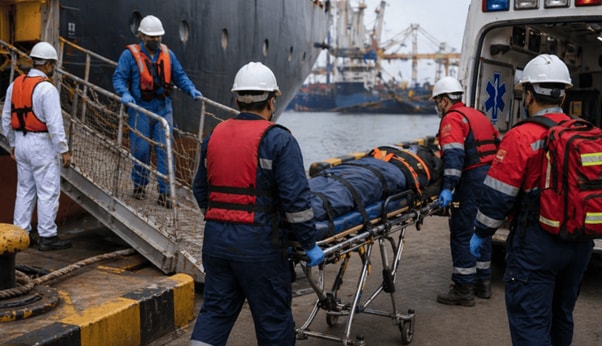
5. Arrange Disembarkation and Medical Transfer
For cases requiring shore-side treatment, the crew member must be safely transferred from the vessel.
This may involve boat transfer from anchorage or direct disembarkation at berth. Once ashore, the crew member is transported to the designated medical facility, often using an ambulance or specialized transport.
Speed and coordination are critical at this stage to ensure timely medical attention.
6. Manage Documentation and Reporting
Accurate documentation must be prepared throughout the process.
Details of the incident, medical condition, actions taken, and communication records should be documented clearly. These records are required for reporting to authorities, insurance purposes, and internal company procedures.
Proper documentation also supports transparency and compliance.
7. Adjust Crew Change Arrangements
A medical emergency may affect the original crew change plan.
If the affected crew member is unable to continue, travel arrangements must be revised. Replacement crew may need to be arranged, and schedules must be adjusted accordingly.
Coordination is required to ensure that vessel operations continue without disruption.
8. Medical Evacuation for Critical Cases
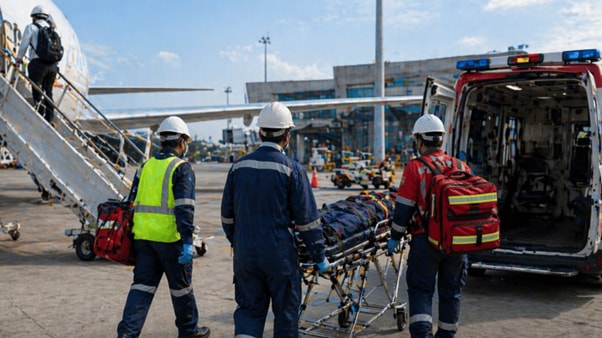
In life-threatening situations, medical evacuation may be required.
The ship agent coordinates with emergency response centers to arrange evacuation by helicopter or boat, depending on location and urgency.
This process requires immediate communication with rescue coordination centers and strict adherence to safety procedures.
In life-threatening situations, medical evacuation may be required. The ship agent coordinates with emergency response centers to arrange evacuation by helicopter or boat, depending on location and urgency. This process requires immediate communication with rescue coordination centers and strict adherence to safety procedures. To understand how these moving parts align in a real-world scenario, you can review this case study on handling a seafarer’s medical emergency in Indonesia, which details the synchronization required between anchorage transfers, ambulance positioning, and hospital admission.
9. Repatriation and Follow-Up
Once the crew member is stabilized, repatriation arrangements may be required.
This includes organizing travel, medical escort if necessary, and coordination with airlines and authorities. Hospital handling, billing, and reporting are also managed during this stage.
Follow-up communication ensures that the crew member’s condition is monitored until recovery or return.
Handling Different Types of Medical Situations
Medical emergencies can vary in severity and require different approaches.
Life-threatening cases require immediate evacuation and hospital treatment. Less critical conditions may be handled through onboard assessment or clinic visits before deciding on further action.
In cases involving infectious diseases, additional procedures such as isolation, health testing, and coordination with health authorities are required to prevent further risk.
Key Responsibilities of the Ship Agency
The ship agency acts as the central coordinator throughout the process.
Responsibilities include arranging medical support, coordinating with authorities, managing documentation, and ensuring that all actions comply with local regulations.
The agency also maintains communication between the vessel, medical providers, and ship owners to ensure that decisions are made efficiently.
Preventive Measures and Best Practices
Preparation plays a significant role in managing medical emergencies effectively.
Crew members should undergo medical checks before deployment to reduce the risk of onboard incidents. Ship agents should maintain a network of reliable hospitals, clinics, and emergency services that are available at all times.
Clear communication channels and pre-arranged procedures help ensure that responses can be carried out without delay.
Supporting Safe and Efficient Crew Change Operations
Medical emergencies during crew changes require a balance between urgency, coordination, and compliance.
Balancia Ship Agency manages these situations through structured procedures, strong local coordination, and continuous communication with all involved parties. From initial response to follow-up and repatriation, each step is handled carefully to ensure proper care for the crew member while maintaining operational stability.
With the right preparation and execution, medical emergencies can be managed effectively without disrupting the overall crew change process.
BALANCIA SHIP AGENCY
HQ Address : Komplex Ruko Golden City Block C No.3A, Batam City, Indonesia 29432
www.balancia.co.id
Mobile Ph. : +628112929654
Office Ph. : +627784883769
References:
- Joshi, A. (2019, February 26). 5 Methods Of Medevac at Sea. Retrieved from Marine Insight: https://www.marineinsight.com/guidelines/5-methods-for-medevac-or-evacuation-of-personnel-at-sea/
- Medical Care at Sea and Beyond. (2022, January 9). Retrieved from Text Book of Maritime Health: https://textbook.maritimemedicine.com/volumes/medical-care-at-sea-and-beyond/5-1-risk-based-approach-etc.html